Showing posts with label joan. Show all posts

10.07.2012

Life Without "Red"


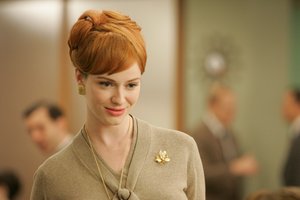
I’m going to take you on a journey to an alternative universe; one where chocolate is a vegetable, Snooki won an Emmy for “Best Actress in a Drama Series”, and our favorite redhead wasn’t on Mad Men. In this alternative universe, actress Christina Hendricks, who we know as the sassy Joan Harris (nee Holloway) was cast as the part she originally auditioned for in 2007: Midge Daniels. Okay, so she would be around, but only as one of Don Draper’s many mistresses who would soon be only a name on a list of women. All hypothetical situations aside, thinking about Christina Hendricks not portraying Joan creates a space to asses the influence of actress Christina Hendricks on Hollywood, the character, and the image of Mad Men itself. 

It goes without saying that Christina Hendricks is stunning, and could even go as far as to say that she has audiences universally stunned with her look and figure. Seriously, even on the show the male characters salute her butt, and women off the secretarial pool aspire to be her. This love of her body has been translated to real life as well. Christina Hendricks was named the new face of Vivienne Westwood's jewelry line “Get a Life.” Westwood chose Christina Hendricks because she believes that “Christina is the embodiment of beauty…” as she represents a return to the old glamour of Marilyn Monroe and pre-Twiggy models who were full figured and voluptuous. In addition to designer admiration, real women are also taken with her curves. One fan gushed to her “You look like what a real woman is supposed to look like, thank you for showing everybody you don't have to be a waif to make it in Hollywood.” The influence of Joan’s figure even inspired surgery; the British Association of Aesthetic Plastic Surgeons attributed a ten-percent rise in breast augmentations in 2010 to her full figure. 
Hendricks personality also helped change the writing of Joan’s character, and her embodiment of the character has lead to a life of its own outside of the show. Matthew Weiner had a different idea for the character of Joan, until Hendricks was cast. His original concept of Joan was a “smaller and mousier and sharper-tongued,” and the way she portrayed her helped develop a new persona to Joan, making her into the Joan we know and love today.  People have taken the words written for this iconic character and translated it to real advice. There are websites that explain “What Would Joan Doin any-given real life situation, proving that she is not just a character. Her fan’s desire to understand her and take advice from her shows her character’s cultural influence on modern women. 
If the alternative universe existed, what would have happened? Would we be more in love with Don’s mistress Midge then any of his other mistresses or then his wife? Would we have been as captivated with a woman who is a “typical model size” as much as we have felt inspired by Joan’s relatable figure? Would Peggy have found her way in Sterling Cooper without Joan’s forward advice? We may never know. But I must applaud the creators, producers and casting directors on a job well done. Christina Hendricks, in my opinion, was the perfect choice; regardless of any other roles she will play in my eyes she will always be Joan. She defines and portrays a character that in turn has helped to make Mad Men into the culturally influential show that it is today. Who knows, without her, the show may have never made it past season one.

10.06.2012

Philosophy Summed Up in a Single Sentence


Sometimes the best, most memorable dialogue on a TV show is a short, one-line sentence.  In numerous TV shows we often see a recurring character drop a line that is comedic, thought-provoking, and memorable.  These quotes are often referred to as the character name with the given suffix-isms.  The trend originated from the character Brittany from Ryan Murphy’s Glee, notorious for dropping comedic one-liners, which people began to call “Brittanyisms” to suggest that Brittany’s lines was its own unique kind of philosophy.  But –isms have spread across numerous TV shows.  Mad Men itself has manifested some great one-line philosophies of its own through the character Joan.  Rarely do we ever see Joan carry a conversation, but when she speaks it is sharp, witty, and concise, thus earning her fair share of “Joanisms”.  Some examples from Mad Men include:
"The medium is the message.”  (Season 1, Episode 6 “Babylon”)
“This isn’t China.  There’s no money in virginity.” (Season 1, Episode 9 “Shoot”)
"That’s life.  One minute, you’re on top of the world.  The next, some secretary is running over your foot with a lawn mower” (Season 3, Episode 6 “Guy Walks into an Advertising Agency”)
While a fair share of Joanisms are indeed comedic, they also embody everything about the sixties from gender roles to cultural perspectives.  With Joanisms having such a lasting effect on viewers, it’s a friendly reminder that while Mad Men consists of a lot of talk between advertising men, it’s often Joan’s lines that wrap up the episode’s theme in a single lasting sentence.

9.28.2012

If You Got It, Flaunt It

--> -->
Helen Gurley Brown, the author of Sex and the Single Girl and former editor of Cosmopolitan Magazine, recently died at the age of 90, leaving behind a long legacy of emboldening “a generation of women with her controversial views about female sexuality, and laid the groundwork for today’s sexualized fashion and celebrity culture.” In August 2012, Booth Moore wrote an article for the Los Angeles Times entitled “Helen Gurley Brown Leaves Behind Lusty,Busty Legacy." In this article, Brown is portrayed as a feminist trailblazer and the inspiration for characters like Carrie Bradshaw and of course, Mad Men’s Joan Holloway.

Moore briefly elaborates on Brown’s early professional life as an executive assistant at the Los Angeles based advertising agency Foote, Cone & Belding, where she eventually became a copywriter (similar to the future career path of Joan). No information is given on how she became the editor of Cosmopolitan Magazine, but Moore does describe how Brown adamantly supported the use of scantily clad women on the cover of Cosmo to both bolster sales and promote the concept that women should own their sexuality.  

Quotes from Brown’s peers make up the majority of the article, and while these quotes further illuminate Brown’s modern views on sexuality, Moore does not connect them to the social implications of Brown’s actions. Moore does mention in passing that the new Cosmo covers sparked an interest in “Miracle bras”, but what about the reception of the covers. A more in depth analysis on Moore’s part would shed light on the various social implications of a woman embracing her body. This in turn would strengthen his argument about the connection between Brown and Joan by demonstrating how they let go of society’s traditional views surrounding women and endured society’s critiques in the pursuit of independence. Moore’s article fails at portraying how difficult it was for women to define themselves and not let a man’s perception of her define her.

Moore’s article is effective in that it adds more depth to a seemingly one-dimensional character by equating Joan to an early champion of women’s rights. In Season One of Mad Men, Joan is portrayed as the femme fatale of the office. Feminist is the last thing that comes to mind while we watch her purposefully ignite the passions of the men prying for her attention at Sterling Cooper (remember the Belle Jolie scene?). Moore’s article casts Joan in a different light. Suddenly her flirtatious smile and curve hugging dresses are not things for women viewers to envy, but something we should all be proud of, a woman in control of her sexuality.

2.09.2011

Adultry Is Everyone's Problem

The first time I watched Mad Men one of the main flaws I found in almost all of the adult characters was infidelity. No matter how much I wanted to relate to the cast, and to view Don Draper as my protagonist, this one major flaw slapped me in the face. From as long as I can remember adultery has been in the headlines. From my parents’ discussion of the Clinton scandal dominating the room, to last week my roommates' critical examination of the broken marriages of Tiger Woods, Sandra Bullock, and Jenifer Aniston (just to name a few). Adultery has never been spoken of as anything less than a sin growing up, and there is no reason why I or anyone else with my upbringing would consider it the same thing. Yet, if you turn on the television or surf the web you are guaranteed to find images of adultery are clear. The 1960s and last week are no different when it comes to the appropriateness or existence or adultery.

Mad Men does not shy away from showing their audience their leading men and women straying from or participating in the act of adultery. This is not shown because “sex sells” but because adultery was common place during this period, especially in the higher classes of American society. Don Draper and Roger Sterling are merely products of their time. Women were in on it too. In 1962, one of the bestselling women’s books was Sex and the Single Girl by Helen Gurley Brown, the editor and chief of Cosmopolitan magazine from 1965-1997. Gurley Brown instructs young women how to work the system in which they were restrained by. She taught them many lessons that she learned during her 30+ years of being a single girl in the city from how to be financially sound and choose the best roommate, to how to chase a married man. This book was controversial at the time mainly because she voiced what was already being done behind closed doors. Joan Holloway is a great example of a woman who is sexually independent and allows men of every marital status to help her get the things she wants in life without toiling with the idea of marriage. Society is aware that adultery is a sin, and grounds for divorce even, but this does not hinder most people from straying. Gurley Brown in I’m Wild Again published in 1999 wrote a section about adultery. She asked one of the married men she had an affair with why he felt he “needed” to stray. The response was shocking; it was not selfish or deflecting the issue, he merely said “It just felt civilized."

I feel it is important for Mad Men’s audience to keep this in mind as they watch the series - to see it more as a cultural norm or rather something that was expected of them. People of that time married for different reasons, went to college for different reasons, and loved for different reasons. To compare them to today’s cultural standards is unfair and from my personal experience can build biases in your mind toward the show. Even though the reasons to turn to adultery may be different for today’s married couple, the rate of which marriages are ended due to marital infidelity seem to mirror the past. Today there are even dating websites devoted to adultery. These sites such as AshleyMadison.com, are providing an easier way for married people to stray. No longer are men confined to finding a woman on a train or taking off their wedding ring when entering a bar, but they are able to openly advertise for what exactly they are looking for. Are we today still as naïve about the severity and vastness of adultery as were the people of the 1960s? Or are we just as equally blinded by denial and refuse to consider that not everyone plays by the same rules taught to us? Or even that we ignore the rules when it comes to our own lives?

Sources referenced: Mad Men Unbuttoned: A Romp Through 1960s America by Natasha Vargas-Cooper

12.03.2010

Everyone knows the many aspects of life in the sixties have evolved to fit today’s culture. However, one of the biggest changes is evident when looking at relationships. After examining season one of Mad Men more closely, I realized that almost ever married male character has cheated on his wife. The classic example is Don Draper. Don has multiple affairs, repeatedly disrespecting his wife, Betty. There is also Pete Campbell, who gets married right at the beginning of the show but then sleeps with secretary, Peggy Olsen, multiple times, eventually leading to an unwanted pregnancy. Finally, there is Roger Sterling, cheating on his wife with executive secretary, Joan Harris.

In today’s culture, this type of cheating and lying is unacceptable in relationships. It is called a ‘scandal’ at that. A relationship is ended almost immediately when the knowledge of an affair comes about. In today’s world, yes, people are definitely more open to their sexuality. However, people are less prone to be accepting of cheating. Yes, cheating does still take place and is very common at that. Although, it is the character of the person who was cheated on that has really evolved.

In Mad Men, characters like Betty Draper who clearly know that their husband is not being faithful choose to just ignore it instead of acting against it. People today realize they don’t have to stand for that type of behavior. Betty may have just ignored it to protect her reputation or keep her family together. However, whatever the case, she made herself seem naïve and almost pathetic in the eyes of everyone else. In addition, characters like Peggy Olsen and Joan Harris represent women who know they are seen as the “women on the side” to these men.

However, they easily accept these roles and play along. Hopefully today, we can see a difference in this. Women today, for the most part, are not satisfied with this type of role. Women today also have more rights to opinion and therefore speak up for themselves more often than in the sixties, which may be the main reason there has been any type of evolution at all.

9.29.2010

And You Might Consider Wearing a Scarf

The wardrobes of "Mad Men" are adored.  They’ve turned the phrase “Mad Men” in to an adjective used to describe any clothing deemed 60s chic.  Countless articles have been written about them.  They’ve even sparked clothing lines at Banana Republic (“Mad About Style”) and a Don Draper suit at Brooks Brothers.  The attention to detail evident in Wiener’s work is one of the many reasons why so many are drawn to his character’s clothes, fans and actors alike.

“The clothing is just amazing.  Her hats alone, you could write a book,” said Alison Brie in an interview with Nylon Magazine.  The interview went on to reveal that she couldn’t take anything from Trudy’s wardrobe because the show often repeats clothes characters have worn.  “I’ve tried to weasel out some gowns, but I haven’t stolen anything [because] if I’ve worn it, it stays in Trudy’s closet.  Which is something I love.’"

Mad Men recently auctioned off select set and wardrobe pieces for charity, including Joan’s dress which sold for $1,324 and Betty’s dress which went for $2,025.  The show’s fashions highlight the day to day dressing we’ve lost.  The public obsession with Mad Men has bled in to trying in some small way to relive it. We can’t go back in time, but at least we can dress like we did.

Links referenced: Lauren Ward, “Mad Men,” Nylon Magazine, August 2010, 202, Mad Men Joan Harris Dress, Ebay, Mad Men Betty Draper Dress, Ebay, David Colman, “Dressing for Success, Again,” New York Times, December 16, 2009.

5.12.2010

Joan and Peggy: The Student Becomes the Master

A subplot during the first season of Mad Men is the fascinating power-play between Joan Holloway and Peggy Olson. The first episode is Peggy’s first day on the job, Joan Holloway instructs her on both professional and personal matters. Joan makes it clear that she is comfortable with the traditional view of women and tells Peggy to start taking birth control and show more skin – a firm believer in exploiting her physical charms. Peggy is nervous and meek throughout the episode, getting the birth control prescription and being overly modest. The show highlights their differences through many techniques, not limited to costumes, camera angles and lighting.

A perfect example of their dynamic occurs in Episode 5 where Peggy is forced to entertain Betty Draper and her children while Don is away from the office. She is almost certain that he is with his mistress and is at a loss on how to deal with the situation. She begins to panic and seeks the help of the all-knowing Joan Holloway. Peggy is flustered and anxious compared to the calm demeanor of Joan. The implications are obvious; Joan is the master, and Peggy is her disciple. Peggy blurts out a panicked few sentences, wrought with insecurities regarding her ability to deal with the situation, while Joan looks on with almost quiet amusement.

The non-verbal elements play a definitive role in this scene. They are standing close together, and the physical contrast is significant. Joan stands nearly a foot taller than Peggy; her posture is upright, confident and relaxed. She is dressed in a stylish, formfitting dress with large earrings that shine in the dull light, topped off with her hair pulled up almost like a crown. On the other hand, Peggy is dressed in a very simple fashion, none of which plays to her advantage. Her blouse is buttoned to the neck, she wears no earrings and her hair is set in a simple ponytail.

The camera position alternates between Joan and Peggy’s shoulders. From Joan’s perspective, she is looking down at Peggy whose eyes nervously flicker back and forth, never making eye contact as she stands against a dull background, blending in to her surroundings. Whereas, Peggy is looking up to Joan, who looks on intently as a light in the background shines just above her fiery red hair. Joan forces Peggy to reveal Don's secret affair; using it as an opportunity to teach Peggy one of the faux paux of a secretary.

This scene epitomizes the influence that Joan had on Peggy’s life initially. As the season progresses, Peggy distinguished herself as being creative and original. She is asked to write ‘copy’ on subsequent products, with great success. Finally, in the last episode of the Season, Don Draper promotes her to the position of a junior copywriter, effectively giving her a position above Joan.

While there is no true animosity, it is an engaging evolution by which Peggy first learns to survive through Joan’s help and then comes to outrank her as she becomes more confident in her abilities.

4.23.2010

In Episode 6 of Season 1 of Mad Men, Sterling Cooper is working on the Belle Jolie lipstick account. In one particular scene, the secretaries have been led into a room to try out different shades of lipstick while the men watch from behind a one-way mirror. The transition into the scene is noteworthy, as the account executives say they cannot understand the women (“they don’t speak moron”) and refer to them as chickens. This scene is stunning both visually through the costuming and in the gender roles that are expressed during the scene.

The costuming is truly effective in this scene because it immediately tells the audience about each character. The woman from the research department, Dr. Greta Guttman (Gordana Rashovich), who has a “man’s” job, is wearing a masculine grey suit and grey shirt, the manliest wardrobe for any of the female characters. From previous episodes, the audience knows that this woman is not accepted by the men or by the other women. She, like her costume, is somewhere in between what was expected in the gender roles of a man and a woman in the workplace of the 1960s. Her palate of grey is just as boring as she is to all of the other characters.

http://www.madmenepisodes.com/wp-content/uploads/2008/11/episode-6.jpg

Joan (Christina Hendricks) stands in stark contrast, wearing a vivid red dress that shows off her feminine curves, as well as highlighting her bold character. Red is associated with passion, desire and lust which perfectly fits Joan’s use of her sexuality in the workplace. When wearing red, all heads turn to Joan, her usually eye-catching look taken to extreme. Red also symbolizes power. Joan’s power over the other women is very clearly shown in this scene because they all look to Joan before answering the researcher’s questions, as though they are seeking her approval.

https://blogger.googleusercontent.com/img/b/R29vZ2xl/AVvXsEgLd15oPmc5EvzikUhnhDergB6NkxtldFnVkaHtpD75YnefJof79_xB3F_0bX2AuJ-Pt2FQJkEX0hIgnh51QRxvchfyPlzrCw7H6oWmD1jVcKl41KGv23JhaY8v29RlfNy1P5JMLoybP2mi/s400/madmen6.jpg

Peggy (Elizabeth Moss), dressed in a conservative and juvenile outfit, does not participate with the other women in trying on many shades of lipstick. Her brown dress is rather boring compared to the other secretaries’ pastel outfits. Brown traditionally denotes masculine qualities, and its frequent use in her wardrobe foreshadows her future rise to a masculine job. Also the color of the earth, brown implies genuineness and wholesomeness. Peggy is seen as a very naïve girl, still genuine in comparison to the people she works with. The styling of Peggy’s dress is oddly matronly and stiff with a very high neckline, letting the audience know she isn’t using her sexuality to advance in the workplace. Clearly Peggy is set to contrast Joan, both in personality and costume.

The wardrobe for the women of Sterling Cooper, while stunning and era appropriate, helps progress the narrative by telling the audience more about the characters. The color and styling of each costume gives further understanding of the complexities of each character. Each of these women’s roles in the workplace is typified by her costuming.

4.18.2010

It's a Barbie World

With the first season the Mad Men taking place in 1960 and the Barbie brand being introduced in 1959, it was only a matter of time before the two industries merged together. Sold at around $75.00 per doll, Barbie and Ken will soon become one of four characters in Mad Men: Joan Holloway, Roger Sterling, Don Draper, or Betty Draper.

But do the characters of Mad Men fall too close to home to be a typical Barbie doll? Is Betty Draper not a Barbie doll herself? This draws an interesting question; now that we see the damage and disloyalty that truly lies behind the perfect “Barbie doll” characters on Mad Men, does that make the image of Barbie and Ken less perfect?

This is something the creative executives at Barbie marketing took under consideration. As stated by Stuart Elliott in his New York Times article about the subject, “The dolls come with period accessories like hats, overcoats, pearls and padded undergarments, but no cigarettes, ashtrays, martini glasses or cocktail shakers." It turns out, it doesn’t matter whether you are living in 1960 or 2010; when it comes to advertising, image almost always takes precedence over truth.

3.30.2010

In Episode Nine of Season One, entitled “Shoot”, we see a tense exchange between Peggy (Elizabeth Moss) as she returns Joan’s (Christina Hendricks) dress that she previously borrowed from her. It seems this confrontation has been building up all season as Peggy and Joan have often disagreed on many things. Peggy and Joan represent two very different types of women, with different goals, and very different ideas about what constitutes success. These differences eventually lead to jealousy and cruelty—an unfortunate side effect of success for women in the workplace.

Throughout the season, Joan attempts to offer Peggy advice on how to attract a potential male suitor, and while her intentions are good, this advice does not particularly work out well for Peggy (case and point: her extremely awkward attempts at flirting with Don in “Smoke Gets in Your Eyes”). Despite Joan’s attempts, Peggy is more interested in advancing her career at Sterling Cooper than landing a husband, something Joan finds difficult to understand. Joan’s power comes from her sexuality and her power over men, and she believes, like many women did at the time, that finding a husband was the most important thing in a young woman’s life.

As a result of this, she tells Peggy that her recent weight gain will prevent her from “doing well” and finding herself a husband. Peggy retorts with a prideful look on her face, “I’m the first girl to do any writing in this office, since the war.” To which Joan replies somewhat confused “Writing? Is that what this is about? I thought you were only doing that to get close to Paul.” This quote is another example of historical references in Mad Men as Peggy mentions that she is the first female copywriter since the war, referring to the mass employment of women during World War II.

With many of the men overseas, women had to fulfill traditionally male roles in the work place, including the advertising world. Despite the massive gains for women during the war (financial independence, learning new skills, putting their education to work), it was largely seen as a “special situation” that would only last until the war was over and the need for labor diminished. At the end of the war, many women were forced to give up their jobs to make room for returning veterans, and return to their domestic roles. The 1950’s were a large step back for the progress of women—though we begin to see that change in the 1960s, and Peggy Olson is a prime example.

However, from this point Peggy and Joan’s conversation grows increasingly cruel, as they each point out the others shortcomings. Joan essentially tells Peggy that the reason she was able to work on accounts is because the wife of a client was not worried about Peggy’s involvement (insinuating she is not a threat because she is not attractive). Peggy becomes defensive and retorts, “You know, you’re not a stick…I know what men think of you—that you’re looking for a husband, and you’re fun. And not in that order.” Peggy’s expression then softens, and she tells Joan, “I just realized something…you think you’re being helpful” to which Joan replies, “Well I’m trying dear.”

This short exchange between Joan and Peggy may seem only indicative of their relationship with each other, but it represents the pressures and dynamics between women at the time (though things haven’t exactly changed much). Joan’s way of thinking is more traditional in the sense that she feels a woman’s ultimate goal should be to get married and quit her job. Peggy, on the other hand, is more progressive in her views. Peggy truly enjoys working and wants to advance her career at Sterling Cooper and chooses not to focus on finding a husband. The two women continue to put each other down, not being able to understand their differing mindsets. This trend of pressuring and putting each other down is something women have been doing a long time—often at the cost of the mutual advancement. One of the reasons feminist movements did not happen earlier is because women were often isolated, and would oppress and criticize each other (usually out of jealousy). One could interpret Joan’s ‘concern’ as thinly veiled jealousy, as she has been working at Sterling Cooper for a long time but has yet to receive a promotion, or a husband. Despite her jealousy, Joan does try to help Peggy, albeit in a condescending way, and as Peggy realizes this she feels less hurt by Joan’s criticism. Their relationship is a complex one and a result of the restrictive and contradictory environment for women in the early 1960s.

3.12.2010

Scandal in the Office

What book could be so scandalous that Joan is discreet about it? In “Marriage of Figaro”, Joan (Christina Hendricks) discretely returns Lady Chatterley’s Lover to another secretary, Marge (Stephanie Courtney). When Marge gives it to Peggy (Elisabeth Moss), Joan advises her that it would attract the wrong type of person if she read it on the train. Written by Englishman D.H. Lawrence in the early 1920s, Lady Chatterley’s Lover was one of the most commonly banned books of the early 20th Century. It is the story of an aristocratic woman in post-WWI England whose husband became injured after their marriage, driving her to elicit affairs with a playwright and the gamekeeper on her estate. The novel’s explicit descriptions of sex and its use of words that were unprintable at the time led to its being banned in the United States.

Book banning was a major issue across America in the early 20th Century. In 1930, US Senator Smoot petitioned the recent repeal of banning foreign published books. The Senator declared “I'd rather have a child of mine use opium than read these books” and “I've not taken ten minutes on Lady Chatterley's Lover, outside of looking at its opening pages. It is most damnable! It is written by a man with a diseased mind and a soul so black that he would obscure even the darkness of hell!” His fire and brimstone speech convinced the Senate to return to the old system of banning foreign published books. In 1959, however, a court case repealed the ban and salacious foreign novels could then be legally enjoyed by Joan, Peggy and Marge. Even though the book was legal, its themes were still extreme taboos in polite society. Fortunately, we can all now enjoy Lady Chatterley’s Lover by simply visiting our local bookstore; just don’t take it on the Metro, as it still attracts the wrong kind of people.


Links Referenced: Bibliomania and "National Affairs: Decency Squabble" from Time.

2.18.2010

Technical Problems

The Pilot episode, “Smoke Gets in Your Eyes," makes a few minor blunders in terms of technological history. The first time we meet Peggy, Joan introduces her to a typewriter and assures here it’s "simple enough for a woman to use." The typewriter in question is the IBM Selectric II, which was not released until 1971. Indeed the original IBM Seleca wasn’t released until 1961. As this episode was based in 1960, it was an artistic liberty taken by Mad Men, which allowed for technology to magically appear before it was developed.

The audience is once again confronted by the technological limitations of the time when Don claims that there is no "magic machine" that can make identical copies of documents. This is particularly interesting since the first Xerox machine was introduced in 1949. However, these are trivial details that pale in comparison to the overall spectacle that is Mad Men. Let’s draw the line at flying saucers.

Links referenced: TV.com and Wikipedia.