Showing posts with label politics. Show all posts

10.22.2012

The Television Election: Marketing Nixon vs. Marketing Kennedy


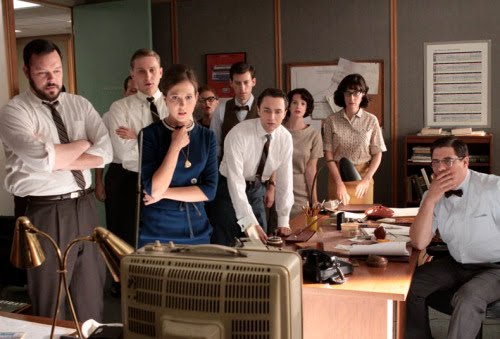
Within the episode “Red in the Face” of Mad Men: Season 1, the viewer is introduced to the major struggle of the 1960 election for the best advertising campaign. Not only was this election the usual struggle between parties, but also the struggle of which candidate could perform best in America’s living rooms. No longer were Americans simply listening to debates on the radio or reading about the candidates; they could also watch them on television and see their reactions. The television audience for politics ushered in a new era of political campaigns. And, as history has proven, President Kennedy used it to his advantage in 1960.

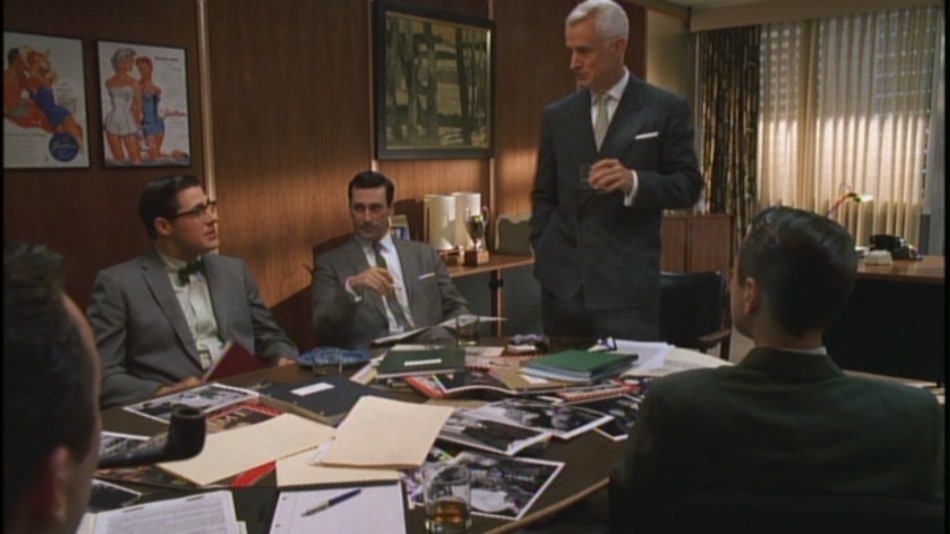
In this episode of Mad Men, the gentlemen discuss the Kennedy Campaign and Nixon. They discuss his inexperience, his Catholic faith and the fact that according to Mr. Cooper, “He doesn’t even wear a hat” as issues working against Kennedy. Peter Campbell responds with, “You know who else doesn’t wear a hat? Elvis, that’s what we’re dealing with.” In this short interaction between the old guard of Sterling Cooper and a younger employee, a magnified lens of the national attitude is witnessed. Overall, the nation would soon decide that Kennedy was a better choice both because of his political ideology and aesthetically because of his apparent youth (He was only 4 years younger than Nixon). His ability to capture a television audience that was young and politically informed was a keystone in his campaign. Television advertising and how the candidates appeared in debates had an influence on public opinion in this election for the first time.

These next two video clips display how the campaigns were different in the way that they approached television advertising. Carefully notice the two different styles used to communicate with the American public.


Nixon was more formal and less remarkable in his ads such as this one. There is no “Zinger” or any type of jingle to make this ad memorable. He focuses in on facts and talks directly to the people leaning on a desk. Although the image conveys authority in a sense, it does not appeal to the public as much. The desk and the way that Nixon uses it as a prop seems removed from the American public whereas Kennedy is shown interacting and shaking hands. While Nixon stuck to traditional forms of advertising, Kennedy’s campaign was more creative in using jingles and other attention grabbing techniques. Thus, the first use of television “Star Power” came into play during the election cycle. 

Nixon was more formal and less remarkable in his ads such as this one. There is no “Zinger” or any type of jingle to make this ad memorable. He focuses in on facts and talks directly to the people leaning on a desk. Although the image conveys authority in a sense, it does not appeal to the public as much. The desk and the way that Nixon uses it as a prop seems removed from the American public whereas Kennedy is shown interacting and shaking hands. While Nixon stuck to traditional forms of advertising, Kennedy’s campaign was more creative in using jingles and other attention grabbing techniques. Thus, the first use of television “Star Power” came into play during the election cycle. 


Both campaigns also contended with the first series of television debates in presidential campaign history. Upon closer inspection of the photo above, it can be observed that Kennedy is more confident on stage and does not look nearly as pasty. Nixon does not look confident and seems to be out of sorts. Overall, the debates soon sank Nixon who did not wear make up and was usually sweating bullets. His posture, debate style, and confidence in front of the cameras were not as fully developed as Kennedy. The difference between the two men in debates was another key advertising move that was a win for Kennedy. Finally, in “Nixon vs. Kennedy”, the Election Day results flow in with a victory for Kennedy. This end game result is a great tie in with Mad Men and the development of television campaign advertising during the time frame. Overall, the election of Nixon vs. Kennedy was the first foray of political campaigns into television as the main medium of advertising. This particular election cycle in history had a profound effect on advertising campaigns and dovetails perfectly with Mad Men: Season 1.

Links referenced:

Druckman, James M. "The Power of Television Images: The First Kennedy-Nixon Debate Revisited." The Journal of Politics 655.2 (2003): 559-571. Article Stable URL: http://www.jstor.org/stable/3449821

Self, John W. "The First Debate over Debates: How Kennedy and Nixon Negotiated the 1960 Presidential Debates." Presidential Studies Quarterly 35.2 (2005): 361-375. Article Stable URL: http://www.jstor.org/stable/275526874


9.25.2012

An Inaccurate Portrayal: Homosexuality in Advertising

Image credit: afterelton.com

In May of 2012, David Leddick wrote an article for the Huffington Post entitled, “Being Gay in the World of Mad, Mad Men: What It Was Really Like." Leddick’s article contests the idea that Salvatore Romano (Bryan Batt) is an anomaly in the advertising business because of his homosexuality. He contests also, the anti-gay opinion of the advertising world of Mad Men. As Leddick was an openly gay, junior writer in the 1960’s, he seems well qualified to make these assertions. However, Leddick’s generalizations about gay men and advertising take away from his point. Both David Leddick, and Matthew Weiner, creator of Mad Men, however, seem to be at least, partially right in their differing portrayals of gay men in advertising.

Throughout the article, Reddick recounts his many successes in advertising, notably with Revlon. In reference to clients of his, “they didn't have time to care about what other people did in bed. They only cared about what you did in the office." Leddick substantiates these claims with his high salaries and examples of his achievement that continued to rise despite his sexuality. His article is refreshingly uplifting compared to Mad Men. His article exudes a feeling of freedom, at one point stating, “If you can do it, you can be it." Leddick also describes the openly gay environment at a particular agency in which he worked, stating that, “all the art directors were gay” and that “the gay men on staff knew everything there was to know at the time about clothes, interior décor, you name it."

It is these generalizations, which continue to occur throughout the article, that ruin Leddick’s point. If Weiner was close minded to the reality of openly gay men in advertising, then Leddick is equally close minded to the possibility of there being closeted gay men in advertising, or even New York City for that matter, stating, “If you were gay in New York, you didn't need to run around hiding it." And even Leddick concedes that “stuffy, old-line agencies […] the big ones” discriminated based on homosexuality. Though Sterling Cooper is not among these companies, it is not completely out of question to believe that intolerance existed in this world as well. Though Matthew Weiner may be naïve to the possibility of openly gay men in advertising, his goal is not to represent strictly the Madison Avenue advertisers and their lives. Weiner uses Mad Men as an outlet to represent the unrest and injustice of the sixties as a whole. Through this Weiner is able to stress sense of sin and hostility toward homosexuality, feelings which were not uncommon during the time period. After all, it was considered an illness until 1973.

Ultimately, though Leddick provides an uplifting and direct account of gay advertising in the sixties, he shows us only one glimpse into a world which involved thousands of individuals, as well as remaining unmindful of the purpose of Mad Men as a show.

2.15.2011

Election Returns: Nixon vs. Kennedy

"Nixon vs. Kennedy" is a unique episode in that throughout the episode the audience gets to re-live the Election Day coverage from the perspective of the characters. The episode is littered with instances where the audience gets to see authentic footage on the characters black and white televisions allowing to track the progress of the election returns. There are a number of clips from this episode relating to election controversies that are briefly mentioned that warrant more analysis.

22 to 1?
Perhaps the most shocking clip of authentic election coverage came at the beginning of the episode when the NBC broadcast boldly stated, “With early returns just coming in, our NBC computer is putting Senator Kennedy’s odds at a grim sounding 22 to 1.” This news-bite comes to the approval of all those working at Sterling Cooper who were Nixon supporters. The reason this clip is so alarming is because the audience knows that the polls leading up to Election Day were incredibly close and that the difference in the popular vote was only about .1%. It turns out that as soon as the same NBC computers predicted unfavorable results for the Nixon campaign their legitimacy was completely dismissed by the Nixon Campaign Manager Len Hall. He adamantly proclaimed, “We should put all those electronic computers in the junk pile.” While it is clear that computer predictions of election winners today is not as significantly flawed as they were in in 1960, they still can be somewhat unreliable today.

What is the Electoral College?

“I don’t think that's a conversation appropriate for children.” This is the response to Sally’s seemingly simple question, and Don's lack of an answer can be somewhat puzzling. It is a wonder why he simply didn’t remark somewhere along the lines that, “The people of the United States vote for the electors who then vote for the President." The audience can only speculate why he failed to explain this, but I was able to come up with three possible theories. It could have just been a way to cover up not knowing what it was. He may have not wanted to explain the concepts of electoral votes to his young daughter who may not have understood it anyway. A final possible theory of why it may not have been “appropriate” may have something to do with the uniqueness of the electoral college system. The United States functions on a two party system which makes it incredibly difficult for anybody but the Republican candidate (Nixon) or the Democratic Party (Kennedy) to win any electoral votes. 1960 was interesting in that an unpledged Democratic candidate, Harry Flood Byrd, wound up winning 15 electoral votes. One of Byrd’s most noteworthy political stances was his advocation of segregation in public schools which is a quality that perhaps may not be “appropriate” and could have possibly tarnished Sally’s innocence.

“I’ve read three different newspapers with three different results.”

The election in many cases was too close to when Nixon refused to concede and went to bed instead at around 4:00 A.M. This did not prevent the press from printing the election results anyway. One of the most interesting stories documented about a newspaper running the presses proclaiming a winner while the election was still close to call was The New York Times. As the night continued and the results were becoming closer, Times Managing Editor Turner Catledge admitted to becoming increasingly nervous that he would be embarrassed in a similar fashion The Chicago Tribune was embarrassed when they printed “Dewey Defeats Truman.”


Image credit: http://www.myptsmail.com/hotdog256/blog/?p=2272

Sources referenced:
http://www.washingtonpost.com/ac2/wp-dyn/A36425-2000Nov16?language=printer
http://www.time.com/time/printout/0,8816,826750,00.html
http://uselectionatlas.org/RESULTS/national.php?f=0&year=1960

2.10.2011

In Danny Miller’s article “In Defense of Betty Draper,” he describes how hearing harsh criticism of Betty makes him defensive due to her parallels with his mother. He, and like many other viewers of Mad Men, see the Draper family’s struggles and hardships as memories from their childhood in the 1960s. Like Miller, my own mother and grandmother identify with the characters on the show: my mother with Sally and grandmother with Betty. In Betty, my grandma sees herself waiting up for her (now ex) husband to come home to Short Hills from his job at Saks Fifth Avenue in New York City. Like Don and many other men of the time, my grandfather was unfaithful, and eventually my grandmother left him. My mom sees herself in Sally when she excitedly receives the horseback-riding boots from Betty as a present to distract her from her missing father in the season two episode “The Mountain King.” In Don’s confident work attitude they see my grandpa and his friends. They see the show and feel like they are watching home movies; everyone had a girl like Carla, all the housewives smoke, drank and gossiped, and many the men “worked” late.

The fact that so many people can relate this well to the show illustrates just how good of a job the writers are doing at depicting the time period. One episode that proves this point is season three’s “The Grown-Ups”. This episode depicts the Kennedy assassination and its aftermath. It shows the shock and sadness that swept through the country as Walter Cronkite reported the incident moments after it occurred, and it shows the devastation of the American people when Kennedy was officially pronounced dead.


Image credit: http://farm3.static.flickr.com/2754/4071248743_fd83e1aa48.jpg?__SQUARESPACE_CACHEVERSION=1257251717247%22%20%5Ct%20%22_blank

One of the things that stands out most in my mother's mind is how Sally and Bobby were glued to the television, just as she and her younger sister Jane were at the time. The wedding of Margaret, Roger’s daughter, trying to continue on the day after the assassination despite more than half the guests missing depicts just how difficult a time it was for the nation. Even those in attendance at the wedding would slip away to catch the news updates. Not only were many guests not in attendance, but waiters also did not show up and guests had to help themselves to the food. The next morning when Lee Harvey Oswald is shot on live television we see the shock and outrage of the American people through the reactions of Betty and Pete. The episode continues to follow the characters through Monday November 25th, the day of JFK’s funeral. Peggy and Don are the only ones to come into the office: Peggy because she cannot bear the sadness from being around her roommate and family and Don because he cannot stay at home and all the bars are closed. The whole country stood in mourning that Monday, everyone in their own way, and Mad Men is able to capture that feeling and share it with its viewers.


Image credit: http://thisrecording.com/storage/IMG_2131.jpg?

11.30.2010

Put That In Your Pipe and Smoke It


John F. Kennedy’s presidential campaign in the summer of 1960 used Jackie Kennedy Onassis, his wife, as a key figure. Beautiful and well-spoken, she was known to the nation already as a fashion icon. In an effort to reach out to the Spanish-speaking voters, she filmed a commercial for Kennedy entirely in Spanish, as shown above. In it she says:

“Dear Friends, the wife of senator John Kennedy, candidate for the US Presidency, is talking to you. In these very dangerous times, when the World peace is threatened by Communism, it is necessary to have in the White House a leader able to guide our destinies with a firm hand. My husband has always cared for the interests of all the portion of our society who need the protection of the monetary government. For the future of our children and to reach a world where true peace shall exist Vote for the Democratic party on the 8th of November. Long live Kennedy!”

Since Sterling Cooper is running the advertising campaign for Nixon during this election, Harry Crane is charged with keeping tabs on the television ads for the opposing candidate. As soon as this reaches the Sterling Cooper boardroom, in Episode 9 of Season 1 (“Shoot”), they begin discussing damage control. Ken complains “I don’t understand it,” and Paul Kinsey’s retort is, aptly, “Because it’s in Spanish.” This quick boys’ club exchange passes quickly because morale is rather low, especially when Don points out that Nixon’s eight-point lead in the polls “isn’t much.”

Mad Men shows the election from the perspective of the Sterling Cooper advertising agency so as to make viewers think about just how influential television was in the election, for the first time ever. Today, we expect to see campaign advertisements on almost every commercial break in the last few weeks leading up to a presidential election. In 1960, advertising agencies were paving the way for the first ever televised presidential election, with the debate as the main event. Some will even argue that, had the debate not been televised, Nixon would not have come across so poorly in it. Had television not been a factor in the election at all, Nixon might have served his presidential term long before the Watergate scandal. Imagine that next time you see a political ad on television.

Links consulted: "Jackie Kennedy Speaks Spanish"

2.26.2010

yes, it's kennedy, kennedy, kennedy, kennedy, kennedy, kennedy, kennedy for me!

Many say the reason Kennedy won the 1960 election was the televised candidates debate. Television played a major role in the election of America’s youngest and first Catholic president. Two different advertising companies were responsible for bringing Kennedy’s two hundred advertisements to America’s living rooms.

On the first season of Mad Men, Episode Ten, the office watches this iconic Kennedy ad:


This catchy jingle is a hard one to get out of your head. It might have even swayed you to rethink your vote. This ad is simple and to the point. It subtly reminds you of important issues without flooding you with information that is anti their opponent. This Nixon ad was also featured on the show.

The Kennedy jingle was revolutionary because it hadn’t been thought of before. It was the perfect compliment to the “out with the old in with the new” ideas that defined Kennedy’s campaign. Nixon’s ad is just so typical; it is what is expected of a classic grass roots candidate. The youthful approach to Kennedy’s campaign is ultimately why Nixon looses to the “new model” that Kennedy represents.

This is the election that truly showed the power of TV, but it was not the first election to use it as an advertising vehicle. Take this ad for president Eisenhower’s 1952 campaign:


Does it look similar? I am sure it does. Kennedy uses the same technique. Both candidates, Eisenhower a republican, and Kennedy a democrat won their elections. Crediting these catchy advertisements with the win would be wrong. However, the recycled tactic allowed for a new product to be marketed. Like, Don Draper (Jon Hamm), says, “Happy days are here again.” The advertisements play on nostalgia. What was old is new. It gives hope to the U.S. citizens when the country’s future looms in uncertainty. It brings safety by recognizing the familiar. This seems to be a repeating theme on the show especially when Don sells the Kodak Carousel in Episode Thirteen of the first season.

Using the old to sell the new is something that is relevant more than ever today. Just look at how many old trends are reinvented in pop cultures many outlets. With the State of the economy and the laundry list of other things that this current administration and the country has inherited it’s no wonder that we are looking to the past to move forward. On more than one occasion Obama has been compared to many leaders Kennedy included. So, it shouldn’t come as a shock that when this commercial for his presidential campaign was created it stirred a positive response:


It plays on all the Kennedy gimmicks a catchy tune, an inspirational speech, an unforgettable slogan, and celebrity endorsement. It’s hard to deny its effectiveness. It reminds the viewer the power of good things. Obama also won his campaign. This is proof that digging through the past to find the latest greatest is more than effective. It wins presidential campaigns regardless of party affiliation and so much more.

What a shame Nixon lost, if only the guys at Sterling Cooper thought of this sooner!