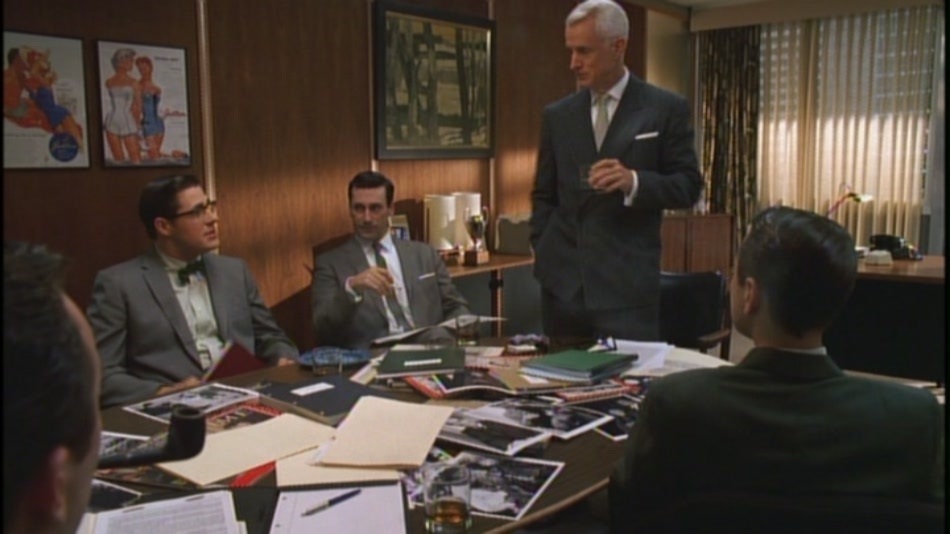

Image credit: http://images4.fanpop.com/image/photos/19100000/Mad-Men-Red-in-the-Face-1-07-mad-men-19195392-950-534.jpg
Within
the episode “Red in the Face” of Mad Men:
Season 1, the viewer is introduced to the major struggle of the 1960
election for the best advertising campaign. Not only was this election the
usual struggle between parties, but also the struggle of which candidate could
perform best in America’s living rooms. No longer were Americans simply
listening to debates on the radio or reading about the candidates; they could
also watch them on television and see their reactions. The television audience
for politics ushered in a new era of political campaigns. And, as history has
proven, President Kennedy used it to his advantage in 1960.
In this episode of Mad Men, the gentlemen discuss the
Kennedy Campaign and Nixon. They discuss his inexperience, his Catholic faith
and the fact that according to Mr. Cooper, “He doesn’t even wear a hat” as
issues working against Kennedy. Peter Campbell responds with, “You know who
else doesn’t wear a hat? Elvis, that’s what we’re dealing with.” In this short
interaction between the old guard of Sterling Cooper and a younger employee, a
magnified lens of the national attitude is witnessed. Overall, the nation would
soon decide that Kennedy was a better choice both because of his political
ideology and aesthetically because of his apparent youth (He was only 4 years
younger than Nixon). His ability to capture a television audience that was
young and politically informed was a keystone in his campaign. Television advertising
and how the candidates appeared in debates had an influence on public opinion
in this election for the first time.
These next two video clips
display how the campaigns were different in the way that they approached
television advertising. Carefully notice the two different styles used to
communicate with the American public.
Nixon was more formal and
less remarkable in his ads such as this one. There is no “Zinger” or any type
of jingle to make this ad memorable. He focuses in on facts and talks directly
to the people leaning on a desk. Although the image conveys authority in a
sense, it does not appeal to the public as much. The desk and the way that
Nixon uses it as a prop seems removed from the American public whereas Kennedy
is shown interacting and shaking hands. While Nixon stuck to traditional forms
of advertising, Kennedy’s campaign was more creative in using jingles and other
attention grabbing techniques. Thus, the first use of television “Star Power”
came into play during the election cycle.

Both campaigns also
contended with the first series of television debates in presidential campaign
history. Upon closer inspection of the photo above, it can be observed that
Kennedy is more confident on stage and does not look nearly as pasty. Nixon
does not look confident and seems to be out of sorts. Overall, the debates soon
sank Nixon who did not wear make up and was usually sweating bullets. His
posture, debate style, and confidence in front of the cameras were not as fully
developed as Kennedy. The difference between the two men in debates was another
key advertising move that was a win for Kennedy. Finally, in “Nixon vs.
Kennedy”, the Election Day results flow in with a victory for Kennedy. This end
game result is a great tie in with Mad
Men and the development of television campaign advertising during the time
frame. Overall, the election of Nixon vs. Kennedy was the first foray of
political campaigns into television as the main medium of advertising. This
particular election cycle in history had a profound effect on advertising
campaigns and dovetails perfectly with Mad
Men: Season 1.
Links referenced:
Druckman, James M. "The
Power of Television Images: The First Kennedy-Nixon Debate Revisited." The Journal of Politics 655.2 (2003):
559-571. Article Stable URL: http://www.jstor.org/stable/3449821
Self, John W. "The
First Debate over Debates: How Kennedy and Nixon Negotiated the 1960
Presidential Debates." Presidential
Studies Quarterly 35.2 (2005): 361-375. Article Stable URL: http://www.jstor.org/stable/275526874