
2.10.2011

In Danny Miller’s article “In Defense of Betty Draper,” he describes how hearing harsh criticism of Betty makes him defensive due to her parallels with his mother. He, and like many other viewers of Mad Men, see the Draper family’s struggles and hardships as memories from their childhood in the 1960s. Like Miller, my own mother and grandmother identify with the characters on the show: my mother with Sally and grandmother with Betty. In Betty, my grandma sees herself waiting up for her (now ex) husband to come home to Short Hills from his job at Saks Fifth Avenue in New York City. Like Don and many other men of the time, my grandfather was unfaithful, and eventually my grandmother left him. My mom sees herself in Sally when she excitedly receives the horseback-riding boots from Betty as a present to distract her from her missing father in the season two episode “The Mountain King.” In Don’s confident work attitude they see my grandpa and his friends. They see the show and feel like they are watching home movies; everyone had a girl like Carla, all the housewives smoke, drank and gossiped, and many the men “worked” late.

The fact that so many people can relate this well to the show illustrates just how good of a job the writers are doing at depicting the time period. One episode that proves this point is season three’s “The Grown-Ups”. This episode depicts the Kennedy assassination and its aftermath. It shows the shock and sadness that swept through the country as Walter Cronkite reported the incident moments after it occurred, and it shows the devastation of the American people when Kennedy was officially pronounced dead.


Image credit: http://farm3.static.flickr.com/2754/4071248743_fd83e1aa48.jpg?__SQUARESPACE_CACHEVERSION=1257251717247%22%20%5Ct%20%22_blank

One of the things that stands out most in my mother's mind is how Sally and Bobby were glued to the television, just as she and her younger sister Jane were at the time. The wedding of Margaret, Roger’s daughter, trying to continue on the day after the assassination despite more than half the guests missing depicts just how difficult a time it was for the nation. Even those in attendance at the wedding would slip away to catch the news updates. Not only were many guests not in attendance, but waiters also did not show up and guests had to help themselves to the food. The next morning when Lee Harvey Oswald is shot on live television we see the shock and outrage of the American people through the reactions of Betty and Pete. The episode continues to follow the characters through Monday November 25th, the day of JFK’s funeral. Peggy and Don are the only ones to come into the office: Peggy because she cannot bear the sadness from being around her roommate and family and Don because he cannot stay at home and all the bars are closed. The whole country stood in mourning that Monday, everyone in their own way, and Mad Men is able to capture that feeling and share it with its viewers.
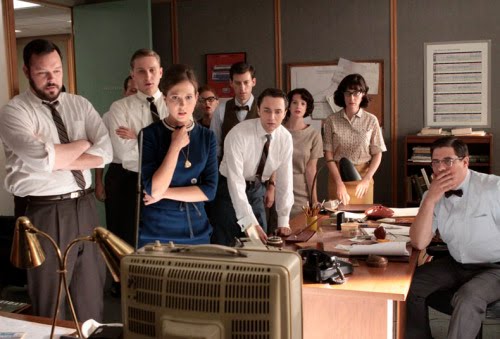

Image credit: http://thisrecording.com/storage/IMG_2131.jpg?

2.09.2011

Adultry Is Everyone's Problem

The first time I watched Mad Men one of the main flaws I found in almost all of the adult characters was infidelity. No matter how much I wanted to relate to the cast, and to view Don Draper as my protagonist, this one major flaw slapped me in the face. From as long as I can remember adultery has been in the headlines. From my parents’ discussion of the Clinton scandal dominating the room, to last week my roommates' critical examination of the broken marriages of Tiger Woods, Sandra Bullock, and Jenifer Aniston (just to name a few). Adultery has never been spoken of as anything less than a sin growing up, and there is no reason why I or anyone else with my upbringing would consider it the same thing. Yet, if you turn on the television or surf the web you are guaranteed to find images of adultery are clear. The 1960s and last week are no different when it comes to the appropriateness or existence or adultery.

Mad Men does not shy away from showing their audience their leading men and women straying from or participating in the act of adultery. This is not shown because “sex sells” but because adultery was common place during this period, especially in the higher classes of American society. Don Draper and Roger Sterling are merely products of their time. Women were in on it too. In 1962, one of the bestselling women’s books was Sex and the Single Girl by Helen Gurley Brown, the editor and chief of Cosmopolitan magazine from 1965-1997. Gurley Brown instructs young women how to work the system in which they were restrained by. She taught them many lessons that she learned during her 30+ years of being a single girl in the city from how to be financially sound and choose the best roommate, to how to chase a married man. This book was controversial at the time mainly because she voiced what was already being done behind closed doors. Joan Holloway is a great example of a woman who is sexually independent and allows men of every marital status to help her get the things she wants in life without toiling with the idea of marriage. Society is aware that adultery is a sin, and grounds for divorce even, but this does not hinder most people from straying. Gurley Brown in I’m Wild Again published in 1999 wrote a section about adultery. She asked one of the married men she had an affair with why he felt he “needed” to stray. The response was shocking; it was not selfish or deflecting the issue, he merely said “It just felt civilized."

I feel it is important for Mad Men’s audience to keep this in mind as they watch the series - to see it more as a cultural norm or rather something that was expected of them. People of that time married for different reasons, went to college for different reasons, and loved for different reasons. To compare them to today’s cultural standards is unfair and from my personal experience can build biases in your mind toward the show. Even though the reasons to turn to adultery may be different for today’s married couple, the rate of which marriages are ended due to marital infidelity seem to mirror the past. Today there are even dating websites devoted to adultery. These sites such as AshleyMadison.com, are providing an easier way for married people to stray. No longer are men confined to finding a woman on a train or taking off their wedding ring when entering a bar, but they are able to openly advertise for what exactly they are looking for. Are we today still as naïve about the severity and vastness of adultery as were the people of the 1960s? Or are we just as equally blinded by denial and refuse to consider that not everyone plays by the same rules taught to us? Or even that we ignore the rules when it comes to our own lives?

Sources referenced: Mad Men Unbuttoned: A Romp Through 1960s America by Natasha Vargas-Cooper

2.08.2011

Critiquing Mad Men

In recent article published in New York Review of Books titled “The Mad Men Account," Daniel Mendelsohn criticizes the amount of praise and accolades given to Mad Men when it is really just a glorified soap opera. He claims that the show has been viewed in too bright of a light and does not deserve to be compared to shows such as The Wire and The Sopranos, both on HBO.

Mendelsohn cites weak writing, a chaotic and oftentimes unbelievable plot, and what he calls a “glib” attitude towards 1960’s culture that positions current attitudes and culture far too superior to it. Instead of creating an in-depth look at the problems of the times, ranging from misogyny to racism, Mendelsohn claims that the writers of Mad Men instead present an unrealistic look into an imagined American society. Similar to Latoya Peterson’s argument in “Why Mad Men Is Afraid of Race," Mendelsohn says that instead of Mad Men briefly introducing a topic such a racism and then ignoring it, the writers of the show should expound more upon this aspect of society. He cleverly calls this the writers “advertising” an issues rather than dramatizing it. In addition to criticizing the work of the shows creators, he also writes that the acting is almost always bland and uncreative, with the actors more focused on playing stereotypes then real people.

Even after showing the flaws of the show, Mendelsohn says that he has watched every episode and will continue to watch. He says the reason for this, and what he assumes is the reason for many other children of the 1960’s, is that is offers them a chance to see the world that their parents would have lived in. They view the world in the ways that Sally Draper and Glenn Bishop would have witnessed it, and Mad Men offers a glimpse into what society could have been.

12.03.2010

Everyone knows the many aspects of life in the sixties have evolved to fit today’s culture. However, one of the biggest changes is evident when looking at relationships. After examining season one of Mad Men more closely, I realized that almost ever married male character has cheated on his wife. The classic example is Don Draper. Don has multiple affairs, repeatedly disrespecting his wife, Betty. There is also Pete Campbell, who gets married right at the beginning of the show but then sleeps with secretary, Peggy Olsen, multiple times, eventually leading to an unwanted pregnancy. Finally, there is Roger Sterling, cheating on his wife with executive secretary, Joan Harris.

In today’s culture, this type of cheating and lying is unacceptable in relationships. It is called a ‘scandal’ at that. A relationship is ended almost immediately when the knowledge of an affair comes about. In today’s world, yes, people are definitely more open to their sexuality. However, people are less prone to be accepting of cheating. Yes, cheating does still take place and is very common at that. Although, it is the character of the person who was cheated on that has really evolved.

In Mad Men, characters like Betty Draper who clearly know that their husband is not being faithful choose to just ignore it instead of acting against it. People today realize they don’t have to stand for that type of behavior. Betty may have just ignored it to protect her reputation or keep her family together. However, whatever the case, she made herself seem naïve and almost pathetic in the eyes of everyone else. In addition, characters like Peggy Olsen and Joan Harris represent women who know they are seen as the “women on the side” to these men.

However, they easily accept these roles and play along. Hopefully today, we can see a difference in this. Women today, for the most part, are not satisfied with this type of role. Women today also have more rights to opinion and therefore speak up for themselves more often than in the sixties, which may be the main reason there has been any type of evolution at all.

12.02.2010

Into the Counter Culture

In the fourth season episode of Mad Men, “The Rejected,” Peggy’s new friend Joyce takes her on a journey into the belly of the emerging 1960s counterculture. They go to a party for a screening of an artist’s experimental film. Underground cinema was a major part of the counterculture movement, and as Juan Suarez notes in his book Bike Boys, Drag Queens, and Superstars, these screenings, often in “run-down art or clearance houses,” served as “rallying points” for unconventional artists and bohemians (67-69). As Peggy enters a New York warehouse, filled with strange partiers, including a man with a bear head, and as she smokes pot while watching an experimental film, one can take note that the series has come a long way from the conservative 1959 suburbia of season one.

Not until the late 1950s did America, and much of the world for that matter, stray in the slightest from the supreme Hollywood film industry. In the 1950s, writers of the Cahiers du Cinema, a French film magazine, started the French New Wave. Its pioneers included Jean-Luc Godard and Francois Truffaut. Their films, such as Breathless (1960) and The 400 Blows (1959), rejected the clean sterile approach Hollywood had been taking, and instead went for a rough aesthetic with continuity errors and abrupt cuts. As writers and filmmakers, they promoted auteur theory, which raised directors to the prestige of artists making works of art. This groundbreaking form of filmmaking made its way to America around the same tame. John Cassavetes, widely regarded as the father of independent cinema, employed similar techniques. His early films, including Shadows (1959), were some of the first independent American films.


But Mad Men depicts the even further dropout from mainstream Hollywood, underground cinema. The movement formed to counter the commercial and professional values of Hollywood, and unlike Godard and Cassavetes, the filmmakers refused to follow any of the norms of mainstream film (Suarez 53). This can be seen in the film projected at the party. Stock footage of rocket launches are accompanied by slides saying, “THE HOLY EUCHARIST,” and it’s set to a track by The Animals. There is no narrative, no actors, and the film doesn’t aim to make complete sense. The use of rock and roll music is also very typical of underground cinema. An example is Kenneth Anger’s Scorpio Rising (1964), a film featuring gay bikers and Nazis set completely to a soundtrack of songs from artists like Bobby Vinton and Elvis Presley.

The shows creators aimed to highlight this emerging movement with “The Rejected.” Although the depiction of 1960s counterculture may be clichéd, it remains accurate to the movement. With these brief first steps into the counterculture, viewers can take note of what to expect from Mad Men as the series delves deeper into the 1960s in the upcoming fifth season.

Source Cited: Suarez, Juan. Bike Boys, Drag Queens, and Superstars: Avant-Garde, Mass Culture, and Gay Identities in 1960s Underground Cinema. Bloomington: Indiana University Press. 1996. Print.

Image: http://www.boston.com/news/globe/living/articles/2007/11/18/still_breathless_after_all_these_years/

11.30.2010

Put That In Your Pipe and Smoke It


John F. Kennedy’s presidential campaign in the summer of 1960 used Jackie Kennedy Onassis, his wife, as a key figure. Beautiful and well-spoken, she was known to the nation already as a fashion icon. In an effort to reach out to the Spanish-speaking voters, she filmed a commercial for Kennedy entirely in Spanish, as shown above. In it she says:

“Dear Friends, the wife of senator John Kennedy, candidate for the US Presidency, is talking to you. In these very dangerous times, when the World peace is threatened by Communism, it is necessary to have in the White House a leader able to guide our destinies with a firm hand. My husband has always cared for the interests of all the portion of our society who need the protection of the monetary government. For the future of our children and to reach a world where true peace shall exist Vote for the Democratic party on the 8th of November. Long live Kennedy!”

Since Sterling Cooper is running the advertising campaign for Nixon during this election, Harry Crane is charged with keeping tabs on the television ads for the opposing candidate. As soon as this reaches the Sterling Cooper boardroom, in Episode 9 of Season 1 (“Shoot”), they begin discussing damage control. Ken complains “I don’t understand it,” and Paul Kinsey’s retort is, aptly, “Because it’s in Spanish.” This quick boys’ club exchange passes quickly because morale is rather low, especially when Don points out that Nixon’s eight-point lead in the polls “isn’t much.”

Mad Men shows the election from the perspective of the Sterling Cooper advertising agency so as to make viewers think about just how influential television was in the election, for the first time ever. Today, we expect to see campaign advertisements on almost every commercial break in the last few weeks leading up to a presidential election. In 1960, advertising agencies were paving the way for the first ever televised presidential election, with the debate as the main event. Some will even argue that, had the debate not been televised, Nixon would not have come across so poorly in it. Had television not been a factor in the election at all, Nixon might have served his presidential term long before the Watergate scandal. Imagine that next time you see a political ad on television.

Links consulted: "Jackie Kennedy Speaks Spanish"

11.14.2010

The Time Without Cell Phones

In Episode 3, “Marriage of Figaro," of Mad Men Season 1, Don drove to pick up his daughter Sally’s birthday cake but did not come back until very late at night. When Don did not show up after one hour after leaving, Betty and the wives fiercely worried and called the bakery. However, they were informed that Don had picked up the cake a long time ago. Since Don was unreachable, the birthday party was almost wasted by the unpredicted absence of the cake.

Imagine what would happen today if Don did not come back on time with the cake. It would not even necessary for Betty to call the bakery. Instead, she would call Don’s cell phone with a single hit on the speed dial key on her cell phone. Even if Don did not pick up the phone, she could leave thousands of voice messages or simply find out Don’s location with some easy-to-use GPS services, for example, the AT&T FamilyMap.

How annoying all these things were going to be if they were available in Mad Men! Don was a man who had frustration in his marriage and needed some private space to think through some issues. Everyone can have personal issues or emergencies, and they usually happen in a bad time. In the case of Don, it was his daughter’s birthday, and the time he was supposed to bring back the cake. For some people, his decision of going to the railroad side to think and drink was irresponsible. Of course, whoever in the position of Betty would not accept Don’s action. However, in the perspective of somebody who needs the private time, the absence of cell phone was the best protection of the privacy and efficient meditation. A thorough meditation might be able to inspire the person to take new approaches to address his or her frustration. In Don’s case, even though there was not really anything indicating the result of his meditation, his uninterrupted private space also allowed him to somehow make up his “wrong doing”-he bought a golden retriever as the birthday gift to Sally. In the show, Don’s returning with the dog did not lead to a verbal conflict between him and Betty. However, if he were called back by cell phone, he would neither be able to finish his meditation, nor avoid a quarrel with Betty, which could be a disaster.

What Don did on her daughter’s birthday party would not be considered right by many people, but his uninterrupted private space might be something that people are jealous of. In the time of cell phone, we do miss the time without it sometimes.